

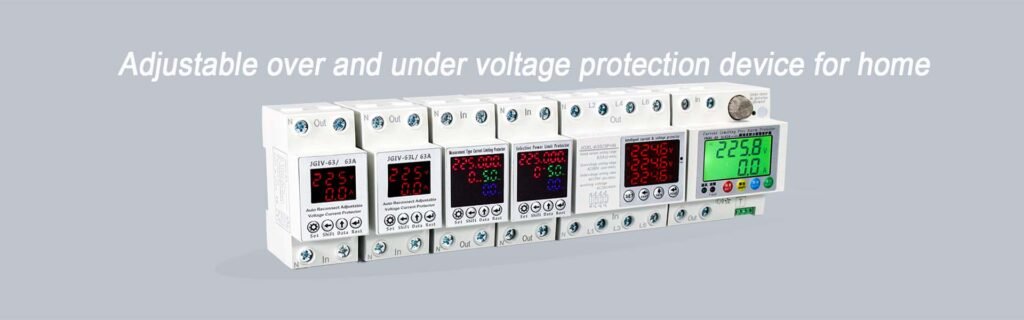
Sudden power outages, flickering lights, or appliances mysteriously shutting down… These issues might all stem from unstable voltage. A voltage protector acts like an “appliance bodyguard,” safeguarding your home electronics during voltage fluctuations. Today, we’ll break down how to select the right voltage protector for your home—so you can understand it at a glance.
Step 1: Identify the Source of Your Voltage Issues
Have you experienced any of these situations?
Light bulbs frequently dimming or brightening unexpectedly
Appliances (especially air conditioners and refrigerators) restarting automatically
TVs or routers malfunctioning after thunderstorms
Unstable appliance operation during peak hours in older neighborhoods
If any of these apply, a voltage protector is worth considering. It primarily addresses two issues: sudden surges (like lightning strikes or grid fluctuations) and sustained undervoltage or overvoltage.
Step 2: Understand Key Voltage Protector Metrics
Don’t just look at price—master these terms and you’ll be half an expert:
Clamping Voltage: Simply put, this is the “protection activation threshold.” Lower values mean faster protection. For homes, choose below 400V—higher values react too slowly.
Response Time: How quickly the protector activates after detecting an anomaly, measured in nanoseconds (ns). Opt for 5 ns or less—faster is better.
Energy Absorption Capacity (Joule Rating): Like a bodyguard’s “stamina,” higher values withstand stronger voltage surges. For standard households, choose 600 joules or higher. For areas with many appliances or frequent lightning strikes, opt for 1000 joules or higher.
Number of Outlets: Count how many appliances need simultaneous protection. Avoid buying too few outlets, preventing overloading a single power strip with multiple high-power devices.
Indicator Lights/Alarm Function: Models with indicator lights or audible alarms are more convenient, allowing you to know promptly if something is wrong.
Step 3: Tailor Protection to Your Appliances
Different appliances require distinct protection:
Basic Protection (TVs, computers, routers, etc.): Choose models with network/phone line protection to prevent surges entering via cables.
Critical Equipment (refrigerators, air conditioners, washing machines): These high-power, expensive appliances warrant standalone high-joule protectors or whole-house surge protectors installed directly in the circuit breaker box.
Precision Electronics (Medical Devices, High-End Audio): Most voltage-sensitive; opt for professional models with voltage stabilization.
Quick Tip: Check the power rating label (in watts, W) on each appliance. Sum the wattage of all devices needing protection; the surge protector’s rated capacity must exceed this total.
Step 4: How to choose between the two main types?
Plug-in surge protectors:
Advantages: Plug-and-play, flexible, and affordable. Ideal for protecting localized appliances like the living room TV or study computer.
How to choose: Opt for models with wider outlet spacing to prevent large plugs from clashing; flame-retardant casings offer greater safety; child safety doors are preferable.
Distribution box surge protectors (also called “whole-house” types):
Advantages: Installed on the main household circuit to protect all appliances. Provides long-term protection but requires professional installation.
How to choose: Ideal for new home renovations or circuit upgrades; highly recommended in lightning-prone areas; requires professional matching to household circuit specifications.
Standard households can start with outlet-type protectors for critical appliances. For homes in lightning-prone areas, older neighborhoods, or those with numerous appliances, invest in whole-house protection.
Step 5: Purchase and Usage Considerations
Brand and Certification: Choose reputable brands and verify the presence of the China Compulsory Certification (CCC) mark for enhanced safety assurance.
Avoid Cheap Options: Protectors priced at 20-30 yuan may only offer basic filtering and could fail instantly during actual lightning strikes or high-voltage surges.
Regular Replacement: Surge protectors are not “lifetime products.” Plug-in types should be replaced every 3-5 years or when indicator lights fail. Whole-house systems last longer but still require periodic inspection.
Proper Usage: Avoid daisy-chaining multiple surge-protected power strips. Keep them away from damp or high-temperature areas. High-power appliances (like air conditioners or electric heaters) should ideally use a dedicated surge protector.

